Tuesday, January 4, 2011

Intel Launches Sandy Bridge Processors

  • Intel Launches Sandy Bridge Processors

Intel has launched one of the most awaited and technologically superior iteration of its desktop and mobile processors - Sandy Bridge - on Monday, January 3, just before the Consumer Electronics Show. Intel was earlier expected to launch it at CES, which is one of the biggest technology fairs of the year.

Sandy Bridge processors have names with four numerals, starting with the number 2 . If it ends with K , then the multiplier is unlocked. It also features a new Turbo Boost Technology 2.0, which can automatically push the core speeds and this time round, they will not limit the speed, so that the overall CPU power consumption remains within the rated TDP.

Sandy Bridge processors feature DirectX 10.1 graphics support, which is a step above the DirectX 10 in the previous generation processors. It will also support version 2.0 of Intel Wireless Display to connect to a display without using wires. DRM is built into the processor and is called Intel Insider. This lets you unlock premium high-definition content such as movies on your PC.

AMD will be releasing Fusion, which is also a combination of graphics with CPU on the same chip, at CES, and Intel's Sandy Bridge may face some competition over there on the laptop front. But the desktop segment seems to have been secured by Intel thus far. The first Sandy Bridge processors in the market will be quad core models, and more will be expected soon. Stay tuned for price updates.

Monday, January 3, 2011

India's Technological Progress Since Independence

Firstly, we wish to take this opportunity to wish you all on the 64th Independence Day of our nation. When we freed ourselves from the shackles of colonial British rule on 15th August 1947, we were left with more of internal conflict and very little in terms of financial reserves or development. It was almost like a clean slate and having to start afresh from scratch. Today, after 63 years from that date, we are still a developing nation with the second largest population on the planet, but we have indeed made a lot of progress. Defence, Computers and IT, Space and Telecommunications are a few of the topics we will talk about to showcase the progress our country has made thus far.
Defence:

At the time of our country's Independence, the Indian armed forces consisted mostly of Emergency Commissioned Officers of World War II and were almost ill-equipped. Our country lacked the infrastructure to produce even a rifle at the time, let alone aircraft or tanks. A foundation had to be laid for the defense industry at that time, especially because there was almost immediate invasion from our neighbors. Modernization of the defense forces was a must. It was a long process which involved several border conflicts, where India learnt about the kind of defense necessary. We also went on to conduct nuclear tests, even risking international criticism and repercussions to irreversibly upgrade its nuclear deterrent capability. While India has been an avid supporter of international nuclear disarmament, the nuclear arms development was purely meant as means of self-defense to thwart any evil schemes of aggressors. Even though it is nuclear capable, India reiterates time and again its No First Strike doctrine.


Today, the Indian Army is equipped with supersonic cruise missiles such as BrahMos, Prithvi I, II and III, Nag, Shaurya, etc. capable of carrying conventional as well as nuclear warheads and capable of striking deep into enemy territory. We also have Exo-atmospheric interceptor system, commonly known as anti-missile technology, which can intercept and destroy enemy ballistic missiles before they reach the target.


In terms of aircraft, we have the LCA and the latest multi-role air superiority fighter Sukhoi Su-30MKI which is jointly developed by India's Hindustan Aeronautics Limited (HAL) and Russia s Sukhoi Corporation. India's own nuclear powered Arihant class of submarines are slated to be unveiled next year, while Shivalik class stealth frigate has been commissioned for this year.


In addition to addition to the Indian Army's arsenal of several different weapons and armoured vehicles developed in India, there is also a new program to modernize the infantry, known as Futuristic Infantry Soldier As a System (F-INSAS) to be commenced in 2012 and to be completed by 2020.

Computers and IT:
While computers have been in use in government institutions and certain colleges in India since 1956, these were off limits to the general public. Supercomputers were not available to India and when a request for one was made in the 1980s to the US, it was promptly denied. So Centre for Development of Advanced Computing (C-DAC) took it upon itself to develop a supercomputer indigenously. In 2003, the Param Padma was launched with development cost stated at US$10 million. This had the computational capability of 1 teraflop (1 trillion processes per second) and a capacity of 5 TB, later increased to 22 TB. This instantly placed India amongst the elite club of nations with supercomputational capability. Then in 2007, the Computational Research Laboratories, a wholly owned subsidiary of Tata Sons Ltd. in Pune, integrated a Hewlett-Packard Cluster Platform 3000 BL460c system with their own innovative routing technology to achieve 117.9 TFlop/s performance. This made it the fourth fastest supercomputer in the world.


Computers started reaching people's homes just a couple of decades ago. The period before that can be considered almost as a dark age in terms of computer literacy here and the enlightenment started in the early 1990s. Today, almost every other urban home has a computer and the rural areas are also not too far behind. The government has also been trying to make computers more affordable, as it was reported a few days back, it has announced the availability of an Android-based tablet PC for just US$35 or around Rs.1650 with the target to make it less than half as expensive later.


From dial-up, we have got broadband virtually everywhere, thanks to EVDO and soon to be rolled out 3G USB modems requiring no wired network infrastructure. This increase in penetration of internet connectivity in rural areas has directly and indirectly affected the lives of people in the villages. There have been initiatives such as e-Choupals by ITC allowing big business conglomerates to link directly with rural farmers via internet, thus bridging the gap and eliminating middlemen. This involves installation of computers in rural areas where farmers can easily access the latest marketing and agricultural information. Currently, there are over 6,500 e-Choupals operating, with plans to expand to 20,000 by 2012 covering 1,00,000 villages in 15 states serving 15 million farmers.
The world recognizes India as an IT giant today. Companies such as Wipro, TCS, and Infosys are globally recognized IT giants with listings on the NSE and NASDAQ. A huge number of IT professionals are produced in India and they are in huge demand all over the world.

Telecommunications:
When it comes to telecommunications, the first thing that comes to our mind is the mobile phone. In 1947, India had a very sparse network of wired telephones and an STD call which was known as Trunk call at that time, had to be specially booked at least half an hour beforehand. The infrastructure of wired telecommunications has rapidly increased so much that just after 10 years from then, there were millions of names in the waiting list for a landline telephone connection.


TRAI was established in 1997 and cellular services were first launched in the country in 1999, and India has never looked back. Today, with a host of GSM and CDMA mobile service providers, the number of mobile telephone users has outstripped the number of landline users by a huge margin. We have arguably the lowest call rates in the world and since internet has become available also through mobile phones, an increasing number of people have been using it for activities such as e-commerce in addition to just staying connected.


After viewing just a handful of terrestrially broadcast Doordarshan channels for more than three decades, satellite television became available in the early 1990s and completely revolutionized the way we watch television. Today, we have HD television channels available from several satellite television providers something that would have been hard to imagine a couple of decades back

Space Technology:
The Indian Space Program spearheaded by Dr. Vikram Sarabhai at the Physical Research Laboratory in Ahmedabad and Dr.Homi Bhabha at the Tata Institute of Fundamental Research in 1945 initially included the study of cosmic phenomenon such as solar radiations. Eventually, the Space Program was taken over by the Indian Space Research Organization started on 15 August 1969.


The first Indian satellite Aryabhatta was launched in 1975 followed by the Rohini series of experimental satellites. While this were the first steps into space for India, the launch of the INSAT or Indian National Satellite System series of satellites was a major milestone due to them bringing a vast improvement in telecommunication. The IRS or Indian Remote Sensing Satellite series was the next successful series of earth observation satellites which provided services useful especially for the agricultural sector and the natural resources industry. ISRO is also in the process of launching India's very own satellite navigation system, Indian Regional Navigational Satellite System (IRNSS), which will eliminate our dependence on foreign satellites for the same.


The latest amongst the achievements of ISRO is the successful Chandrayaan-1 lunar probe expedition in 2008, which carried out explorations of the lunar surface, sending back valuable scientific information. This put India in the elite club of a handful of nations who could manage the successful landing of a lunar probe. Hot on the heels of the first lunar mission, Chandrayaan-2 is already on the anvil with an expected launch in 2013. The next major objective of ISRO is already set and that is to send a manned expedition to the moon by 2020, which they are very optimistic and upbeat on achieving.


We must also mention that there is a variety of Polar Satellite Launch Vehicles (PSLV), Augmented Satellite Launch Vehicle (ASLV), and Geosynchronous Satellite Launch Vehicle (GSLV) designed and used by ISRO to launch satellites and probes. These have been used to launch not only Indian satellites, but have even been used to launch payloads from other countries, thus generating a lot of revenue in this highly profitable business. With our own launch facilities and launch vehicles, we are truly in a unique position which cannot be boasted of by most other nations.

These are not the only fields where India has excelled post-independence. There are other fields such as superconductivity, nanotechnology, nanomaterials, biotechnology, medicine, energy and so many more that it is impossible to cover them all in a single article. Even though we still remain hindered by red-tape bureaucracy, we are surely making strides towards becoming a developed country from a developing country. So before you think about comparing India with a developed nation such as U.S.A., you should give it a thought that U.S.A. has been independent for 234 years, while we have been so only for 63 years, which is a fourth of that period. U.S.A. did not inherit poverty and unrest like India did after its independence. Yet we have come so far that it is indeed an achievement in itself that deserves our respectful salute.

Evil Twins: Mobile Phone Edition 2010

The prologue to purchasing a phone mostly starts when you look at your old, scratched, boring handset and say, "That's it, time to get a new one". With sweaty palms, you scour the Internet for the phone that fits your requirements as well as budget. And then when you've almost finalized on the handset of your choice, an evil twin raises its ugly head. With a similar feature set and pricing, it lures you to have a look at it. You fall prey and eventually end up confused between the two. Sometimes there are more than two.

I believe manufacturers do this exercise before starting their development on an electronic product - 1) Research the market on what's currently selling and what it has, 2) Create a device that tries to match the feature set and price of competitors, 3) Throw in that extra feature that gives them a reason to brag about why theirs is better. To give you a prime example of this, I'd say look at the Galaxy Tab's marketing campaign - video conferencing, its ability to make phone-calls, a "pocket-friendly" design - all these are things that the first Apple iPad doesn't have.

So, in the end it makes choosing between two devices a frustrating affair. Today, we take a look at five pairs of mobile phones that do this and we'll try to clear the mist of confusion.


Nokia C6 vs. Samsung Galaxy 551

Despite touchscreens becoming good enough to provide an easy typing experience, many still prefer tapping on real buttons than virtual ones. Thus was born touchscreen phones with sliding QWERTY keyboards. The Nokia C6 was released as a rebranded, youthful and more importantly, cheaper avatar of the N97 mini. Although it may have hit the market early, it is threatened by Samsung's newest entrant, the Galaxy 551 - which is basically the Galaxy 3 i5801 with a sliding keyboard.

Both have 3.2 inch displays when measured diagonally. The C6 beats the Galaxy 551 in resolution; 640 x 360 pixels are packed better in the former than 240 x 400 pixels in the latter. But Samsung trumps Nokia by using a capacitive screen instead of a resistive one, which is much better to use with fingers.

Next comparison is the operating system - Symbian Series 60 5th Edition vs. Android 2.2 (Froyo). No points for guessing which one's better (OK, if you're still guessing then it's Android, of course). The OS on the Nokia C6 is just too dated in terms of usability, it would've been acceptable if it used the more recent Symbian^3, but not this.

In comparison, the Android 2.2 is the second-best version of Google's mobile operating system that Samsung used in the Galaxy 551. The well-designed interface and over 2,00,000 apps to choose from is a big incentive. Plus, if you're a user of Google applications like Gmail, Google Maps etc., then Android supports all of it natively.

Although the Galaxy's screen isn't as tempting in terms of crispness as the Nokia's, support for DivX videos out of the box is certainly appreciated. Both the phones roughly sell for Rs. 13,000. If I had to choose between the two, Nokia C6's resistive touchscreen and the ancient Symbian OS would make me look in the other direction. I'd rather choose the Galaxy 551 without batting an eyelid.

nokia c6


samsung galaxy 551


Samsung Wave II S8530 vs. Nokia C7

While most manufacturers are fighting the iPhone in the Rs. 30,000 price bracket with their Android-based (and more recently, Windows Phone 7 based) smartphones, there's a bigger price segment that's more lucrative to the Indian consumer - the sub Rs. 20,000 range. It is this price point that acts like a physiological barrier, as anything above Rs. 20,000 is deemed too expensive for a phone by many. We have two competitors trying to make their stronghold in this segment; the Nokia C7 and the Samsung Wave II S8530.

Although the Wave II doesn't have the Super AMOLED display like the first Wave handset, its trump card over the Nokia C7's is the higher 800 x 480 pixel resolution and a slightly bigger screen size (at 3.7 inches). But its not like Nokia's screen is bad - we felt its AMOLED display delivered soothing colors, unlike Samsung's Super AMOLEDs which seem kinda over-exaggerated.

Next is the camera - newbies may want to declare the Nokia C7 as a winner by just looking at the higher 8 megapixel sensor count (the Wave II has 5 mega-pixel). But what spoils it for Nokia is the lack of autofocus. How does that matter? Well, with a fixed focal length any object you click that's either closer or farther than the optimum distance isn't going to be captured with good sharpness. You can read more about the C7's camera here. On the other hand, the Wave II's autofocus sensor will make sure that pictures don't turn out blurry, no matter what the object distance is. If you're keen about using the phone camera, the C7's flaw will pose as a deterrent.

Another important aspect to consider is the Operating System. The Nokia C7 runs Symbian^3, a decent attempt from the Finnish stable with not too many bad things to point out. A few of those black spots like the web browser can be fixed by installing third party apps like Opera. The Wave II runs Bada OS 1.2, Samsung's homebrewed smartphone OS which we found to be quite good for a first attempt.

In fact, we'd go out on a limb and say that we like the Bada OS's Interface better than Symbian (while not trying to sound like Symbian^3 is utter crap). But Symbian is one of the oldest smartphone OSes out there, with an App store that may not match the Apple iOS's or the Android Market, but certainly better than the lackluster availability of apps for the Bada platform as of now.

So it all boils down to this - if stuff like a good web browser, Google Maps or a VOIP app like Nimbuzz or Skype are important to you, the Nokia C7 is your best bet (as you don't have any of those apps for the Bada OS as of now). If you want a good camera phone with superior multimedia and are sure that you won't be pushing the phone beyond what you get out of the box, then the Wave II is a better choice. Want the good camera as well as the decent app support? Then shell out Rs. 5,000 more and get the Nokia N8.

samsung wave II


nokia c7

HTC Desire HD and HTC HD7

This is a fight between two Sumo Wrestler brothers from a single mother. Both are 4.3 inch 'monster-screened' phones - one running Google Android 2.2, the other Windows Phone 7. There are too many things similar with these phones. As for the difference in their hardware, the Android-running Desire HD has a higher res 8 megapixel camera (the HD7 has a 5 megapixel one).

It also is powered by Qualcomm's newer Snapdragon (i.e. QSD8255) 1 GHz processor, while the HD7 runs the first iteration of that processor (although at the same clock speed). The advantages of the newer chip are seen on the graphics front - it's faster but not as fast as the Galaxy S (or the Nexus S). The HD7 has 8GB built-in memory, while the Desire HD has 1.5GB on-board (well, an 8GB microSD card costing Rs. 800 is peanuts if you're spending Rs. 27,000 on a phone).

It is in the software department where the Desire HD kills the HD7 by a long shot. It has over 2,00,000 apps as of now, while the newborn Windows Phone 7's 5000 apps as of now has a long way to catch up. The HD7 won't play DivX videos out of the box (a shame for a phone with a huge screen and comes with a kick-stand), while the Desire HD does. Also, the software incompetency that currently plague Windows Phone 7 OS exist in the HD7 as well. There's no bluetooth file transfer, no Flash support in the web browser, no multi-tasking among other things. Even copy-paste support will be out next year.

The HD7 sells for Rs. 29,000, while the Desire HD actually costs Rs. 1,500 lesser. If you've actually read through the two paras above, it isn't too hard to figure out which phone we'd prefer; the Desire HD, of course. Unless you are really smitten by Windows Phone 7 and cannot do without a feature that it provides that Android doesn't, I don't see any reason why one should go for the HD7 instead of the Desire HD.

htc desire hd


htc hd 7

Sony Ericsson XPERIA X10 Mini Pro vs. Motorola Flipout

Both are mid-range Android phones with QWERTY boards coming out of their bodies. We prefer the X10 Mini Pro for its design because though it may be too tiny for some, its shape is better to hold and pocket than the Flipout's rectangular shell. Also, it has a regular QWERTY keyboard sliding mechanism, while the Flipout's bottom half slides out at a 180-degree angle sideways. This in our opinion isn't really a good design, as it keeps moving when you hold the phone to your ear. Also, you cannot speak on the Flipout without opening the slide, which is not the case in the X10 Mini Pro.

Both the phones don't fare well when it comes to the display due to the low QVGA resolution used. Fonts on the Android appear to have blurry edges thus reducing readability.

The Flipout scores over the X10 Mini Pro with its slightly bigger 2.8-inch screen size, but probably as a result of this, the fonts look even weirder. On the other hand, due to its squareish shape, the Flipout isn't as easy to use single-handedly as the X10 mini pro.

Keyboard wise, both are almost at par - the X10 mini pro's well-shaped and spaced-out keys give as good a typing experience as the Flipout's well-defined and tactile keys. Multi-media is a department where the X10 Mini Pro beats the Flipout, with a 5 megapixel autofocus sensor that takes very good snaps and videos. The bundled in-earphones also give a good audio listening experience.

Motorola has done a decent job with the MotoBLUR UI customization over Android, and so has Sony Ericsson with their rendition. Both phones are available for Rs. 15,000. If you ask me, I'd prefer the X10 Mini Pro out of the two simply because of the unergonomic shape and sliding mechanism of the Flipout, and also because of the better multimedia performance on the X10 mini pro.

sony ericsson xperiax 10 mini pro


motorola flip out


BlackBerry Curve 8520 vs. Nokia E5

A lot of people want to go beyond the traditional forms of communication via their mobile phones (i.e. calling and SMS). People want e-mail, they want Facebook/Twitter, they want to chat using them too. BlackBerry's cheapest model yet, the Curve 8520 has been around for long. Nokia's E5 is its latest attempt to re-hash a premium phone (Nokia E72) into an inexpensive solution. The only thing good about the Curve 8520 is its optical trackpad, which is better to navigate with than frantically clicking on a typical D-pad found on the E5. The keyboard design is a subjective choice; although people dislike the Curve's tiny keys, I like their tactility and the way they are laid out.

But other than that, the E5 whacks the Curve in places where I'd rather not say here. For starters, the E5 is 3G (HSDPA) compliant, has GPS with free turn-by-turn navigation provided other than the obvious possibility to install Google Maps. It has a higher-resolution 5 megapixel camera with an LED flash. Push e-mail is offered free on the Nokia E5 and will work with a typical GPRS plan, while you have to shell out a minimum of Rs. 299 per month for just mail and instant messaging on a BlackBerry (Rs. 599 if you want to browse the net or use applications).

The BlackBerry Curve will not support an upgrade to their latest OS 6. The E5's Symbian Series 60 v.3.2, while not great to use, isn't entirely horrible and will get the job done in most cases. The BlackBerry Curve 8520 sells for Rs. 11,700, while the E5 is available for a grand less than that. Again, it isn't rocket science to figure out which one is the better of the two. But if you're sold on BlackBerry's service, then you've unfortunately got no option but to settle with the inadequacies of the Curve 8520 or spend Rs. 6,000 more and get the Curve 9300 to fix some of the issues.

BlackBerry really needs to drop the Curve 9300's price down to the Curve 8520's range and kill the 8520 entirely. Till then, our vote of confidence lies with the Nokia E5.

blackberry curve 8520, nokia e5


Great Phones that don't Exist!

Sony Ericsson XPERIA X9


There are many Android phones cropping up in the Rs. 10,000 to Rs. 20,000 range, which puts it in the reach of many people. Sony recently announced a couple of new phones, of which, one was the XPERIA X8. A not-so-mini cousin of big-brother XPERIA X10, the X8 seems like a good mid-range Android phone. While HTC and Samsung have decided to put low-resolution QVGA (320 x 240) or WQVGA (400 x 240) displays respectively in their cheap Androids, Sony Ericsson has bravely embraced the HVGA (320 x 480) type, which is a good enough resolution for a 3-incher in our opinion. More importantly, it is one of the first and most common resolutions used for Android phones till date.

This, as we all know by now, ensures compatibility with maximum number of apps (at least from the resolution point of view). All forms of connectivity like GPS, Wi-fi, 3G are in place, and Sony Ericsson gave us a tasty quote of less than Rs. 16,000 as the X8's selling price on launch.

What more could you ask for, right? Two things is what we could think of. Firstly, like everyone else, I am baffled wondering why they'd put a measly 3.2 megapixel non autofocus camera in the X8? And that too when you know how good that 5 megapixel sensor on its X10 Mini and Mini Pro is.

Secondly, as my colleague Prasad observed, the 3-inch display felt a little too small when using the QWERTY keyboard in portrait mode. I would agree and say that if I had to change another thing about the X8, I would like the display to be bumped up to 3.2-inch, which, we by experience know is wide enough for easy portrait typing.

So, enter the Sony Ericsson XPERIA X9, which is pretty much the X8 but with a 5 megapixel sensor borrowed from the X10 mini and the screen size bumped to 3.2-inches. And while we're at it, it better be released with Android 2.1 or above, instead of a promise to update it after a few months of purchase. At 16,000 bucks, perfect eh?
Samsung Galaxy S Mini


I'm sure you are acquainted with the Samsung Galaxy S. This was probably the first phone I felt can give the iPhone a good run for its money. Despite containing that awesomely vivid 4-inch display, I didn't find the phone to be very bulky or un-pocketable in any way. However, many people don't share that impression and feel that four inches is a little too big to be a phone's display.

While we might get carried away by saying its Rs. 27,500 asking price is value for money, but when you compare it to other Rs. 30,000 phones, it does seem to give you a lot better in return. But 30 grand is no small amount.

Right now Samsung's Android portfolio has cheap 12k phones like the Galaxy 3 i5800 and then the next Android phone is more than twice that price. We're barring the aged i5700 Galaxy model since its probably out of the market by now. So now someone who wants a mid-range Android has no Samsung model to choose from.

A "Galaxy S Mini" if sold for Rs. 15,000 - Rs. 17,000 while retaining all those great features like the Super AMOLED display, DivX HD playback etc. would be a godsend. Getting the screen size down to 3.2 inches would also satisfy the dissatisfied people I mentioned before. But wait, don't we have a phone just like that already?

Sure, Samsung wants to promote their home-brewed Bada OS, but according to their plan Bada would slowly trickle down to all the lower-end feature phones like the Corbys. Samsung already has the hardware ready; just slap Android onto the Wave's body and what you've got is a kick-ass Android phone for under Rs. 20,000.
iPhone Mini / iPhone Nano


How we've wished for this to happen over and over again. But we of course are aware of Apple's "Best or nothing" policy. We also know that they're not into the number game and aren't part of the rat-race. But Apple was in a position to hold this attitude a few years ago when no other device was able to touch the greatness of the iPhone. Today though the game is changing.

Google and many of the big cellphone makers have joined hands to make a pool of phones that mimic the iPhone in function. But the difference with Android is of variety. You've got decent choices for half the iPhone's cost. Apple has the right to defend this by saying that they don't make "cheap products that are not a piece of junk".

But look at it this way: India and China are two of the biggest and fastest growing cellphone countries. People here buy cellphones with the same money required to pay for a meal for two people in a posh restaurant. Plus, with all the cheaper Android phones people begin questioning whether it is really worth paying double the price for an iPhone. We are mostly a value-for-money driven country, where the first thing people look at before buying an electronic product is the price.

And don't tell me Apple hasn't tried making cheap products to bring the "Apple Experience" to the masses. What was the Mac Mini? Or the iPod Shuffle? I have enough faith in Apple to say that if they bring a sub-Rs. 20,000 iPhone to the market, it will put all the VFM Android phone makers in a state of panic. So, if Apple wants to cash in on the success of these two big markets, they'll have to tone down their snobbish rich-boy-only attitude with the iPhone.


Nokia N900 Mini


The N900 was Nokia's first attempt to break that Symbian rut they had going with their touchscreen phones. It ran Maemo, a completely new OS from the ground up, which is now pitted to replace Symbian from all top-end Nokia smartphones. It was an interesting device to play with, but as a phone, I found it to be way too bulky for this day and age. In contrast, something like a Motorola Milestone was thinner despite the sliding QWERTY board. And with so many size zero phones in the market today, I'm sure many people would be put off by the N900 due to its size.

It would be interesting to see the hardware internals of an N900 and the Maemo OS placed in the casing of an N97 mini. We'd call it the N900 Mini, and I'm sure it would be a desirable buy for Nokia lovers. Also, why not replace the decade-old resistive touchscreen with a capacitive one?

Micromax Q8


Ok, it's not like we're promoting Micromax over other Indian china-phone makers. The Micromax Q8 is just a symbolic name and we hope similar models crop up from other makers as well.

After seeing the Micromax Q5 and the Q7, I realized that they're good value for money phones that work fairly well. But that one main differentiating factor between Indian china-phones and popular International handset makers is the User Interface. All Indian china-phones may have different skins and fonts that make the UI look a little better, but from our observation all run the same, age-old OS inside. Plus simple things like multi-tasking between Java applications isn't supported in most, possibly owing to the lack of memory or processing power. Then there are the text-input issues that we had explained earlier.

I'd like to dream of the day when a Micromax, MVL, Lemon or even a Wynncom throws that ancient OS out in the gutter and replaces it with a better functioning one. Google Android is open-source; free for anybody to take and modify. But maybe they can't port it to these phones due to the lack of sufficient processing power and internal memory. Think about it, we know how Android lagged a little even on phones with 528 MHz processors and 128MB of RAM. We can't obviously expect these under-Rs. 5000 phones to possess even this much power.

Only if there was a way to skim Android to make it lighter and work better with low-power devices, they'd most definitely give bigger players good competition. With a good web-browser, applications like Gtalk, Gmail and Facebook built-in, they would become true social networking phones for people with small pockets.


Phones to Look Out for in 2011

Nokia N9

nokia n9


Initially we thought of including the Nokia E7 in this list but then we we remembered the Nokia N9 that was leaked a while back. It has everything that the E7 does except for a few things that it does differently, which we believe give it a big advantage over the E7. First of all the N9 runs on MeeGo. Now as improved as Symbian ^3 is, it still doesn't feel thoroughly modern the way iOS, Android or Windows Phone 7 does. But that's because it is an old operating system and although it has learned quite a few new tricks, there is no hiding its age. This is where MeeGo comes in. Being a brand new operating system, it one ups Symbian in a very crucial area, and from whatever we have seen from the images and videos it does look very promising in a way Symbian ^3 never did.

Now when you add this new operating system to the already brilliant hardware of the E7, along with a higher resolution display and a better camera, you have the makings of a very competent smartphone. Not that the E7 would be a bad phone, but we aren't really looking forward to it the same way we are for the N9.

Samsung Galaxy S 2

1.2GHz dual core processor, Android 2.3 Gingerbread, 4.3-inch 800 x 480 Super AMOLED 2 display, 8 megapixel camera with autofocus, 1080p video recording, 16GB storage memory. Those are rumored specifications of the upcoming Samsung Galaxy S 2 that is slated for launch early next year. After listing those specifications I don't think I need to say anymore. If those specs don't excite you, you probably have no interest in smartphones.

Dell Venue Pro

dell venue pro


Dell is not the kind of company that usually makes products that you really look forward to, which why we were a bit surprised when we saw the Venue Pro. Out of the devices that were demoed at the launch of Windows Phone 7, the one that caught our attention was the Dell Venue Pro. Apart from the generally excellent specifications that all the Windows Phone 7 devices must have by default, the Venue Pro also has a great-looking exterior and the comfort of a full QWERTY keypad, which is gracefully concealed under a sliding mechanism. Of the crop of Windows Phone 7 devices out there, this is the one we are looking forward to most.

Samsung I8700 Omnia 7

omnia7


Think of the Galaxy S but in a solid metal body and with a flash for the camera running Microsoft's sexy new operating system. The Omnia 7 is another Windows Phone 7 device that although as made an appearance abroad is still to arrive on Indian shores. Having used the Galaxy S and knowing how good it is, we have a fair bit of confidence in the Omnia 7 and know that it is going to be awesome.

Milestone 2

milestone 2


Another phone that we are yet to get our hands on in India, the Milestone 2 is said to be a huge improvement over the original Milestone (also known as DROID in the US), which itself was a very good smartphone. The Milestone 2 runs on a faster 1GHz processor and has 8GB of built-in memory.

It also dumps the mostly superfluous D-pad on the original Milestone for a more spacious keypad that is said to be more comfortable to use. But at the same time the phone still manages to be just as thin as the older phone, which was the thinnest smartphone with a full QWERTY keypad back when it was announced.

The Milestone 2 also runs on the newer (but no longer the latest) version of Google's mobile operating system, Android 2.2 Froyo. The Milestone 2 has the makings of being one of the best Android smartphone on the market.


Sony Ericsson PlayStation Phone

playstation phone


We have all been waiting for a PlayStation phone for a long time and it seems it will finally be a reality next year. The pictures have been leaked online several times and from what we can see it is an Android 2.3 based smartphone with a slider that reveals not a traditional QWERTY keypad but a proper gamepad like the one you can find on a PSP.

There is the standard D-Pad on the left, the four game controls on the right and what seems like touch based "analog sticks" in the middle with a button in the middle for the L3 and R3 function. If you look on the top (or on the right depending on how you hold the phone) you will also see the shoulder buttons. To be honest, whenever we imagined a PlayStation phone in our head it was very similar to what it looks like in the rumored pictures. We are really glad that although Sony Ericsson took their time with this phone they seem to have done a good job with the hardware.

Now as far as the games are concerned, they will be distributed online through an Android Market-like store on the phone. Users will also be able to play regular Android games that owners of other Android phones have access to. We are really looking forward to this one, and if Sony Ericsson gets this one right it is going to be absolutely awesome.

Sony Ericsson Xperia X12 (Anzu)

xperia x 12


The Xperia X12 is the X10 on steroids. It has a bigger 4.3-inch display using AMOLED technology, a first for a Sony Ericsson phone. It also has a 12 megapixel camera with autofocus and LED flash, hopefully the one from Satio because it was awesome and 720p video recording. It runs on a 1GHz Snapdragon processor but more importantly Android 2.3 Gingerbread, which should make better use of all that horsepower. The rest of the specifications are yet to be fully disclosed, as the handset hasn't been officially announced, but we will find out on February 13, a day before Mobile World Congress 2011.

LG Optimus 2x

lg optimus 2x


Usually, we don't get too excited about LG phones, but this one makes you sit up and take notice. It is an NVIDIA Tegra 2 based phone, which means it combines a dual core 1GHz ARM Cortex-A9 processor and a GPU on a single chip. This allows it to do awesome things such as 1080p video recording, which is not possible on the current crop of smartphones. The Optimus 2x also has a 4-inch display, 8GB built-in memory, 8 megapixel camera with autofocus, gyroscope and flash and runs on Android 2.3 Gingerbread. We will be keeping a close eye on this one.

Apple iPhone 5 (or 4G)

Few things are as certain as a new iPhone every year. We even know when it will be coming out as Apple is known to stick to its yearly schedule. As is usually the case with Apple devices, there is very little to know about them till they actually launch, so this is more like a wish list rather than what the device will actually come with. For starters, we expect it to have 4G connectivity (and be called iPhone 4G). Then it would have a faster 1.2GHz dual core processor, possibly NVIDIA's Tegra 2, considering how good the Apple NVIDIA relationship is. Then we also expect a revised antenna design. There's no way Apple would make the same mistake twice of placing the antenna at a point where it can easily be blocked by a user's hand.
The camera may see a bump as well, mostly in the video recording area. If it indeed comes with Tegra 2 then 1080p video doesn't seem too far fetched as we saw on the Galaxy S 2 and the Optimus 2x. The real question is how Apple will manage to put in a battery that will power all of this. But knowing how seriously Apple takes battery life we can be sure it would be as good as, or even better than the current hardware. It wouldn't be the first time Apple would have defied the laws of physics.

Worst Games of 2010

"Do not envy our kind," is what I keep telling awestruck people when they hear that I play games for a living. For every awesome game, there is ten times as many of the boring kind. For every ten of those, there is at least one that makes sniffing glue at the local railway station sound like a more rewarding career choice; because the drug induced grogginess makes one oblivious to the suffering. And that is one luxury the reviewers forced to play low rent shovelware cannot afford. Unlike those who play games solely for entertainment, we don't have the liberty of choice. We can't just switch off the console and head over to the returns section. So without much ado, here is a list of the worst games of 2010, and may their souls rest in pieces!

Quantum Theory

The term 'humankind ' is a gross misnomer. There is nothing kind about us humans. We are cruel in the way we make T-Rexes, white sharks, grizzly bears, the bubonic plague and Ekta Kapoor look benevolent. I say this because it is the human race that has unleashed unmitigated horrors like the mustard gas, ricin and VX nerve agents, the vacuum bomb and, of course, Quantum Theory upon the world. Yes, Quantum Theory, because it ranks right up there with the most horrid games ever to taint the game industry.

Fortunately, as I was busy pretending to work, my colleague Roydon Cerejo took one for the team and decided to review this game. Okay, I can't lie anymore. The truth actually was that he got suckered in by the shiny trailers on the website and therefore called first dibs on the game. And boy what a bad idea that was! There's nothing much to talk about the game except the fact that it is atrocious in every imaginable aspect. You should, in fact, honor Roydon's sacrifice and read the review to witness the magnitude of its catastrophe. It has been, by far, the least rated title we have reviewed, and for a good reason.

quantum theory


Although I did not play it, I made sure to witness Roydon suffer through the ordeal. It was all funny for the first few minutes, but as the hours passed, I saw his very soul being devoured by the game's repetitiveness and the lack of any character. Quantum Theory's utter dearth of substance or any redeeming quality is like a void - one with its own gravitational field that sucks the last vestiges of happiness out of anyone who's foolish enough to subject themselves to it. Hour after hour, I helplessly saw my colleague drained of his sanity. We had to up his usual dosage of Valium and remove all sharp objects out of the test labs.

I can't possibly fathom anyone putting down Rs. 2,500 for the PS3 title. I can think of a billion more pleasant and productive endeavors that one can undertake instead of playing this abhorrent excuse for a game. The only reason why you see him still push in the articles is because we removed all the ceiling fans and padded the walls. So next time you read the reviews or decide to flame the comments section as usual, please spare a though for all the sacrifices we make for you guys.
Farming Simulator 2011

There is a reason why kids invariably choose doctor, engineer, fireman or film actor, and not pig farming as career choices. You see, dreams and fantasies are supposed to be infinitely cooler than reality, because ten years down the line, a good number of the same kids will be flipping burgers for a living, and no one wants to be reminded of that.

Games, much in the same way, are nothing but fantasy worlds, where you want to do all the cool shit that you don't get to do in real life - like running over the elderly with The Red Eagle, chainsawing and bayoneting Germans or causing a 20 car Bugatti Veyron pileup worth $35 million at the fifth corner of Nurburgring Nordschleife.

farming simulator


Technically speaking, I am a farmer by the strictest definition of law, so I'm well equipped to give a verdict on the game. With all my farming know-how, I can vouch for the fact that this game indeed is a farming simulator in spirit and execution. It is in fact too realistic, which also means it's just as dreadfully boring. I don't know what the developers and publishers were thinking when they gave this one a go ahead. One can't possibly expect to actually put down hard earned money for this tripe. There are a number of things that I would pick up over this game - and that includes herpes, because at least it is fun catching it.

Michael Jackson: The Experience

Make no mistake; I really like Michael Jackson. You have to admit the fact that the guy gave us a great music legacy. That is, at least till the point he went psycho with the plastic surgeries, by when he was too preoccupied attending trials, to be bothered coming up with good music. Even then, the legacy he left behind is too massive to be affected by the weirdness of his latter life. However, Ubisoft's shameless posthumous monetisation, Michael Jackson: The Experience, is just flogging the dead horse.

michael jackson the experience


It's a thankless experience with no redeeming quality. To call it homage to Michael would be a travesty. With damningly bad controls, a lack of career mode and a worthless solo mode, it's clear that Ubisoft had no intention of putting any effort in this cheap cash in. The game is so atrociously bad that if you wind his corpse with copper and hook a magnet and battery to it, you'd generate enough electricity to light up Neverland Ranch again. That's how vigorously Mr. Jackson would be spinning in his grave.

Prison Break: The Conspiracy

There are reasons why movie adaptations do not work, and Prison Break: The Conspiracy isn't even adapted from a movie. It's based on a TV series that jumped the shark and subsequently fizzled out after the very first season. The game tick all those reasons and then some more for the most excruciatingly painful experience. If the developers were a bit more truthful, they would have named it Prison Rape instead, because that is exactly as fun as the game can possibly get. The gaming community was unanimous in deploring this aberration, with many advocating picking up the soap instead of this game.

prison break the conspiracy


As ingenious as the first season of the series was, Prison Break: The Conspiracy is the exact opposite with its unimaginative gameplay, bad controls, retarded AI and a very restrictive linear plot that allows no scope for anything remotely interesting. The game takes the prison part too seriously, and the environments are accordingly drab to the point of making you suicidal. I know the point of games is to be realistic, but a bit common sense is enough to tell which part of reality to showcase in a game and when to resort to artistic license. This virtue is lost upon the developers, which results in a terminally retarded, repetitive and boring snore-fest that is Prison Break: The Conspiracy.


Frogger Returns

I like to think of myself as an old school gamer. In fact, Planescape: Torment and the original Fallout still are my all-time favourite games. That means I'm not averse to HD remakes of old school classics. However, not everything that is old school deserves a remake. Not every game has the gameplay depth of, let's say, a Tetris or Araknoid. Some of the classics were only popular because there weren't many other titles with gameplay and graphics flair of the aforementioned gems. Frogger Returns is a clear example of why not all classics should be remade. The game is just too simplistic to hold player interest.

frogger returns


However, that didn't stop developer Hijinx Games to remake Frogger in 2010. The worst part is that the remake added nothing extra to the classic. The only notable change to the game - the isometric camera angle made things worse by making it impossible to judge incoming cars. The flawed collision detection didn't help matters, making the game just too excruciatingly frustrating to appeal to anyone even with the strongest sense of nostalgia.

Frogger Returns makes me wonder what the folks at Hijinx Games were smoking, when they thought it would be a good idea to release it over Nintendo Wii, DS and PlayStation platforms.


Thursday, December 30, 2010

BSNL Unlimited 3G Data Plan Now At Just Rs. 700

Pan India 3G mobile service operator Bharat Sanchar Nigam Ltd (BSNL) all set to triggering another price war before the launch next generation 3G Mobile and Data service by private operators.

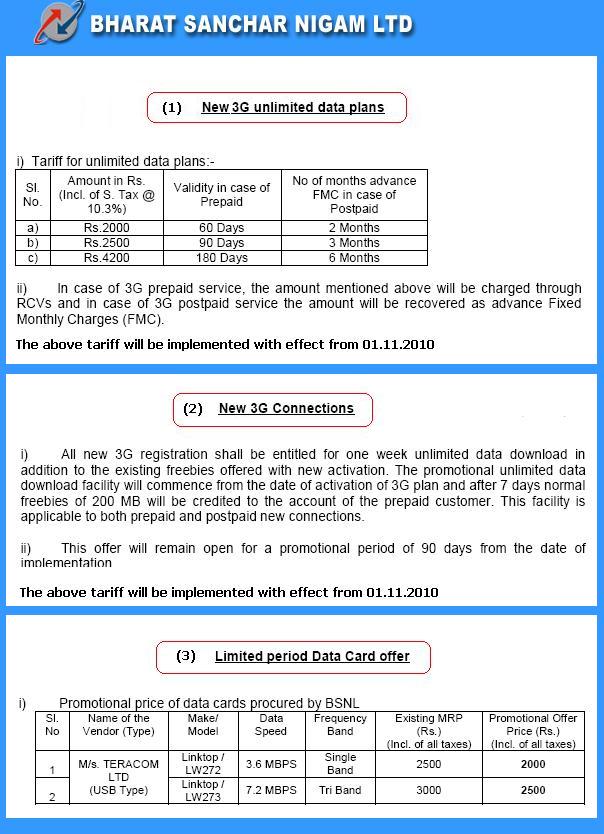
BSNL once again slashes the 3G Unlimited Data Plan cost up to 50% and introduced bucket of new 3G offers including Unlimited Prepaid/Postpaid Advance Rental/Payment Plans, Unlimited Free Data Download

offer for its 3G Data customers and reduction of 3G data card price.


Apart from the ground breaking offer of Unlimited 3G Data Plan at just Rs700 per month, the operator also introduces Free Unlimited 3G data downloads for 7 days as a Festive Season offer wherein new 3G data card subscribers can access Unlimited Free High Speed Wireless Broadband up to 7.2 MBPS without any extra charges for 7 days from the date of activation.

Unlimited 3G Data Plan At Rs700/ Month :

BSNL introduces 3 new “Advance Rental Data Card Unlimited Plan” where in the effective cost of Unlimited 3G Data Downloads will be as low as Rs. 700/month. The new new 3G Data plan for Rs. 4200 comes with the validity of 180 days and provide Unlimited Free High Speed wireless Broadband 24×7 Home and Roam circle anywhere in India.

While the new Data Plan-2500 comes with the validity 90 days while Plan-2000 offers Unlimited 3G for 60 Days.All 3 plans will be available to both prepaid and postpaid new connections from 1st Nov’ 2010.

Unlimited Free 3G for 7 Days:

All prospective 3G Data Card subscribers shall be entitled for one week Unlimited data download in addition to the existing freebies offered with new activation. The promotional Unlimited Free 3G data download facility will commence from the date of activation of 3G plan and after 7 days normal freebies of 200 MB will be also credited to the account of the prepaid customer as a Festival Gift. This facility is applicable to both prepaid and postpaid new connections. The above scheme will be implemented from 1st Nov’ 2010.